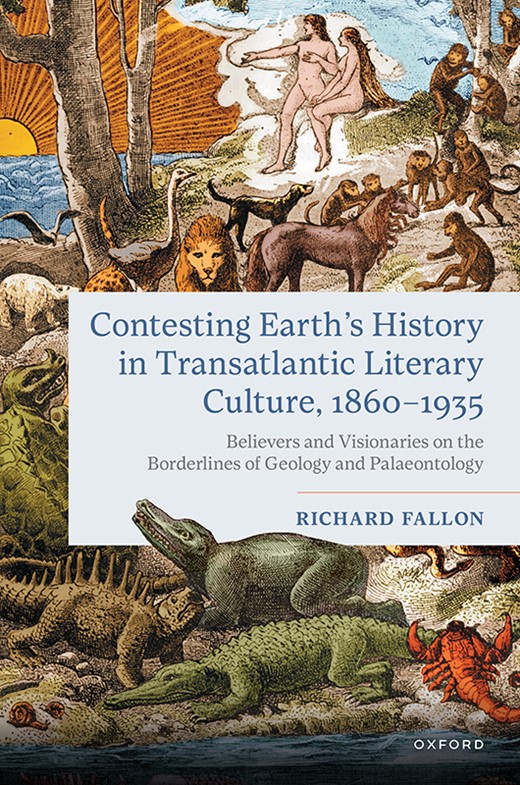
Richard Fallon, KE Fellow at University of Nottingham and Postdoctoral Researcher in Collections and Culture at the Natural History Museum (UK), discussed his book Contesting Earth’s History in Transatlantic Literary Culture, 1860-1935: Believers and Visionaries on the Borderlines of Geology and Palaeontology (Oxford University Press, 2025) in the Greenhouse environmental humanities book talk series on Monday, 1 September 2025.
By the mid-nineteenth century, geologists and palaeontologists had reconstructed an authoritative narrative of Earth’s deep history, from the planet’s molten origins to the rise of humanity. Many figures in transatlantic science across subsequent decades, however, had problems with this narrative: it was too secular, inhuman, and evolutionary, or controlled too exclusively by elite scientists. Speaking from palaeoscience’s unevenly professionalized and controversy-racked borderlines, Christian fundamentalists, charismatic psychics, and respected scholars alike voiced their objections. Until now, no study has brought their work together for detailed comparative analysis. Spanning from the 1860s to the interwar decades, Contesting Earth’s History examines the fascinating history of five significant examples of fringe or ‘borderline’ palaeoscience: old- and young-earth creationism, hollow-earth theory, clairvoyant time travel, and sunken-continent catastrophism. Innovatively combining methods from literature and science studies with the history of science, this book attends not just to the conceptual content of these strange sciences, but also to their proponents’ communication of truth claims through diverse genres ranging from the scientific textbook to the epic poem. Close attention to the hitherto overlooked textual forms and literary strategies of ‘pseudoscience’ throws into relief competing conceptions of science’s audiences, methods, and forms of evidence. The authors examined in this book attempted to shift the balance of scientific power, creating textual spaces where exclusive hierarchies of expertise could be levelled away. Hijacking geologists’ and palaeontologists’ long-standing efforts at making the prehistoric past visible, these authors encouraged readers to gaze into time’s abyss with bold new eyes.
